Transfer Pricing

Share Article
Transfer Pricing Isn’t Just for Big Companies
Lots of business owners think transfer pricing is only for big global companies. It isn’t. If you own more than one company, it probably applies to you.
What is it?
Transfer pricing is the price one of your companies charges another of your companies.
That’s it. It covers anything that moves between them: products, services, staff time, loans, or the use of your brand name.
A simple example
You own two companies: one in France and one in Spain.
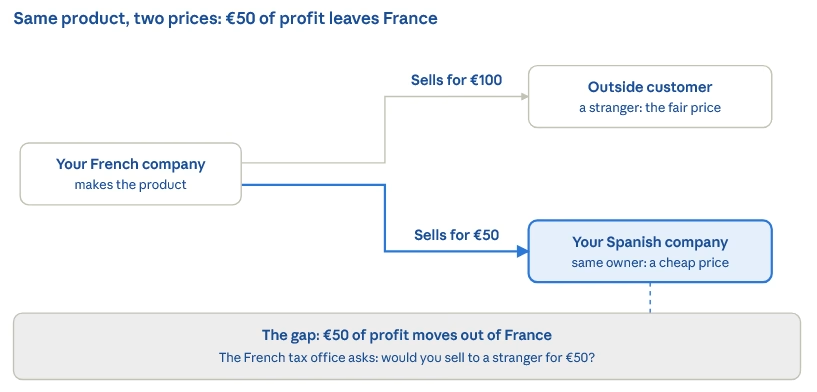
- The French company makes a product. It normally sells it to customers for €100.
- It sells the same product to your Spanish company for only €50.
- The French company now shows €50 less profit, so it pays less tax in France.
To you, it’s all the same money. To the French tax office, €50 of profit has gone missing. They will want to know why.
The golden rule: the “stranger test”
Tax offices ask one simple question:
Would you charge a stranger the same price?
If you’d charge a stranger €100, you should charge your own company €100 too. The official name for this is the “arm’s length principle”, but the stranger test is all it means.
A transfer pricing policy is simply a written note that says: this is what we charge, and this is why it’s fair.
Does this apply to me?
Tick any that sound like your business:
- One of my companies sells things to another of my companies.
- My main company does work for the others (accounts, IT, HR, management).
- One of my companies has lent money to another.
- My companies share a brand name, website or software.
- Staff work for more than one of my companies.
- I pass costs from one company to another.
One tick is enough. You need to think about transfer pricing, even if your business is small.
The example nobody expects
Sophie runs a small business in Cape Town. Last year she opened a small sales company in the UK.
She says: “We don’t sell anything to each other, so transfer pricing isn’t for us.”
But look at what actually happened:
| What Sophie did | What the tax office sees |
|---|---|
| The Cape Town company lent the UK company money to get started, with no interest. | A loan. A bank would charge interest, so South Africa should have earned interest. |
| Sophie and her bookkeeper spend a day a week helping the UK company. Their salaries are paid in Cape Town. | A service. South Africa did work for the UK and wasn’t paid for it. |
| The UK company uses the Cape Town company’s logo, website and customer list for free. | Use of valuable assets. A stranger would have to pay for these. |
Sophie thought she had zero transactions. In fact she has three. Each one moves profit out of South Africa, and each one needs a fair price and a short written explanation.
None of this is wrong or unusual. It just needs to be priced and written down.
What can go wrong?
- You pay more tax. The tax office can decide what the price should have been, and tax you on the difference.
- You pay tax twice. One country may tax the extra profit, while the other country doesn’t give it back.
- You pay fines. Penalties and interest are usually worse if you have nothing written down.
- You lose time. Explaining old decisions years later, with no paperwork, is slow and stressful.
Questions to ask
Take these to your accountant or tax adviser:
- Do my companies charge each other the same as they would charge a stranger?
- Is any of this written down?
- Are loans between my companies charging a normal interest rate?
- Is my main company charging the others for the work it does for them?
- What paperwork do I need in each country I’m in?
The bottom line
If your companies do business with each other, you already have transfer pricing. A simple written policy now costs far less than arguing with the tax office later.
This is general information, not tax advice. Rules are different in every country.